Aging/Research reports/2026-10-01
Protein degradation with functional evidence?
Can targeted protein degradation preserve function without leaving active fragments?
Today's decision: Antibody–LC3 coupling enters the approaches list as preclinical comparator AG-A11. A published functional finding merits follow-up. It confirms neither our TIMP2 hypothesis nor a treatment for human aging. AG-C03 / AG-T01 remains 🔵 Level 2, low confidence. The added literature is ⚪ Level 1. Project level and scientific evidence are separate assessments.
What the new study actually connects
Guo et al., published 26 August 2026, engineered autophagy receptors by coupling antibodies to LC3A to direct selected proteins towards degradation. Two experimental routes must remain separate:
- Tau / small extracellular vesicles: preclinical pathology findings, including intravenously treated TauP301S mice.
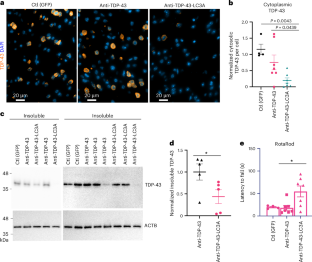
- TDP-43 / AAV: reduced insoluble protein and improved motor performance are reported in TDP-43ΔNLS mice. The rotarod finding belongs to this route.
Source: Guo et al., Nature Biomedical Engineering, DOI 10.1038/s41551-026-01774-9. We inspected the public publisher preview, figures and linked numerical source data. Complete methods were unavailable; critical appraisal therefore remains provisional. Technology-related patent interests are disclosed. No independent replication was verified.
Recalculation: what do the published points support?
Our descriptive recalculation of the published table is not a new study: sheet Fig4e, B2:B8 versus C2:C8, seven values each. Figure 4e labels the endpoint rotarod latency to fall in seconds.
- Anti-TDP43: mean 18.14 s, median 12.00 s, observed range 7.50–47.25 s.
- Anti-TDP43-LC3A: mean 54.61 s, median 68.25 s, range 9.25–93.25 s.
- Difference of means: Σ(LC3A values)/7 − Σ(comparator values)/7 = 36.46 s.
- Sensitivity: across all 49 combinations omitting one value from each group, mean differences range from 28.25 to 48.88 s. This is not a confidence interval.
The direction does not depend on a single tabulated value. Wide dispersion, small counts and unresolved experimental units, allocation and measurement timing prevent robust new inference here. No pairing was assumed, no new p-value calculated, and no human efficacy estimated. Dose, duration, baseline impairment and preservation of normal protein function still require appraisal.
Original source data for Figures 2–7 · Figure 4. Empty cells were not converted to zero; both compared groups contain seven numerical entries.
Countercheck: a detected peptide is not an identified active molecule
The deeper audit of Karabova et al. (6 April 2026, AG-D01) separates peptide detection from seeding activity. Mass spectrometry reported in the main text maps peptides to sequence regions. It does not thereby establish the connected boundaries of an intact, seeding-competent fragment. Activity in a mixture cannot be assigned to an individual detected peptide.
Our conditional inference: If FRET activity is divided by ELISA-detected tau, a truncation-related reduction in ELISA response could increase that ratio. Whether such bias occurs and how large it might be have not been established here. This does not refute observed activity; it limits claims about activity per actual tau mass. Supplementary peptide tables and antibody epitopes could not be directly audited. Primary source, sections 3.5–3.8; DOI 10.1002/alz.71337.
Evidence and the next executable step
- Established information: Publication dates, distinct experimental routes and recalculated table values. No established reversal of aging.
- Promising indication: Connecting targeted protein control to a functional endpoint merits further scrutiny.
- Experimental model findings: Reported protein and motor outcomes come from disease models; they do not establish human efficacy.
- Hypothesis: Selective degradation might help if active residual cargo, loss of normal protein function and synaptic damage are avoided. Today's comparison does not establish this complete chain.
Next executable check: Assess the already identified related primary study DOI 10.1126/scitranslmed.aea4205 for target protein, delivery, model, functional endpoint, duration and shared data/research groups. Compare Guo's study against it rather than combining positive results from different systems into one supposedly confirmed chain. Guo's methods for randomization, blinding, experimental units and time course remain open. A sustained lack of functional benefit or loss of normal protein function would weaken the corresponding benefit hypothesis.
Axolotl regeneration remains a separate repair route; no new axolotl source was assessed today. The approaches will only be connected where a mechanistic link is supported. Expanded approaches list · Cumulative evidence chain.
Search and teaching: Retrieval and analysis 1 October 2026; one new DOI (AG-D03), one deeper existing-source audit (AG-D01). Targeted DOI/title searches found no matching correction or retraction notice; this was not a comprehensive registry audit. Coverage remains selective. Measurement and dependency appraisal deepen AG-P17–20; no additional wishlist assignment before complete methodological review. Professor research colloquium and existing learning packages. No laboratory experiments, independent experimental replication or self-medication advice.
Continue exploring


