Datei:PIA20317-MarsCuriosityRover-NamibDune-Sand-NightCloseup-20160122.jpg


Beschreibung
| Beschreibung |
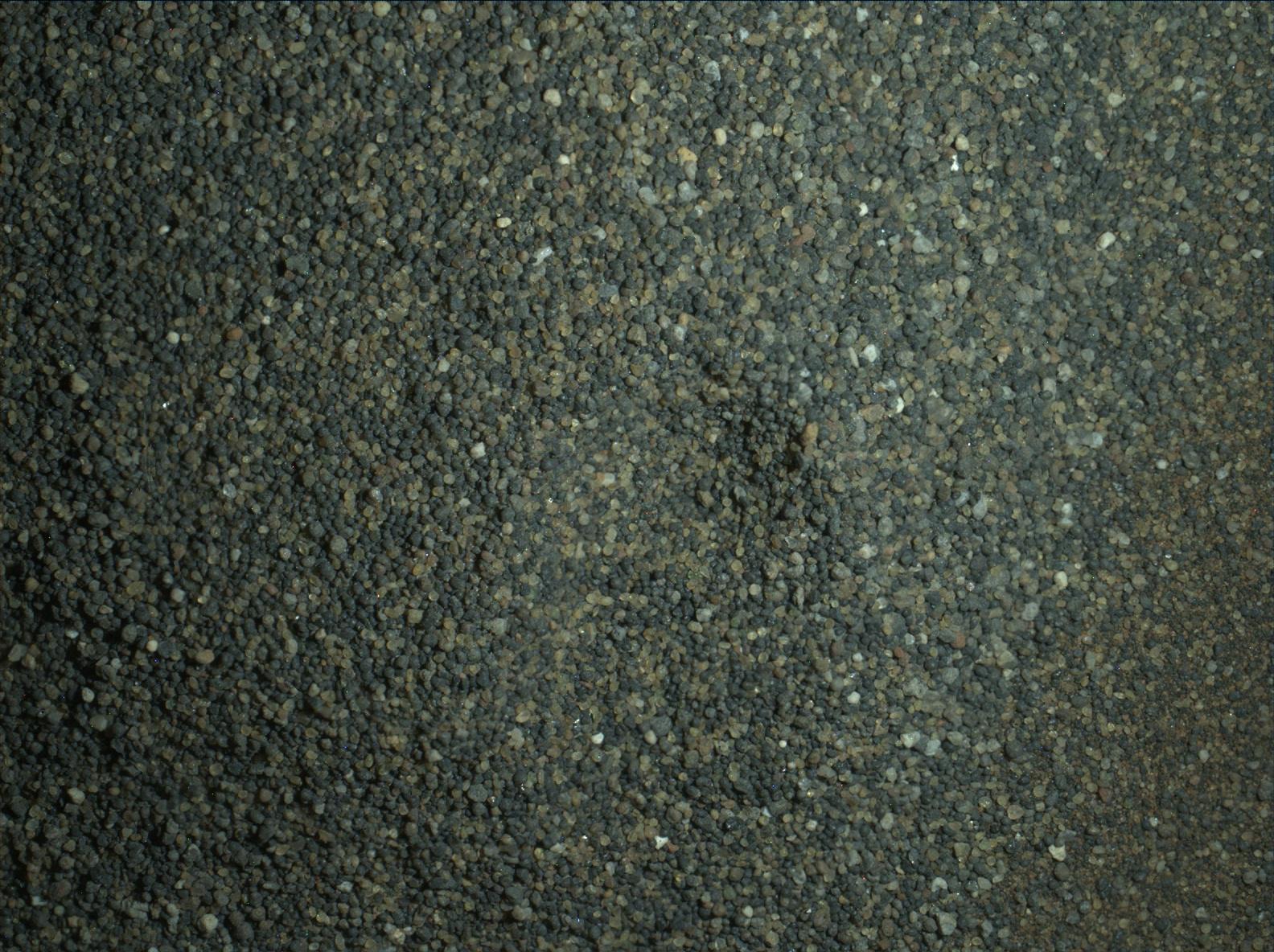
English: PIA20317: Night Close-up of Martian Sand Grains
http://photojournal.jpl.nasa.gov/catalog/PIA20317 The Mars Hand Lens Imager (MAHLI) camera on the robotic arm of NASA's Curiosity Mars rover used electric lights at night to illuminate this view of Martian sand grains dumped on the ground after sorting with a sieve. The view covers an area roughly 1.1 inches by 0.8 inch (2.8 centimeters by 2.1 centimeters). The grains seen here were too large to pass through a sieve with 150-micron (0.006 inch) pores. They were part of the sand in the first scoop collected by Curiosity at "Namib Dune." A different portion of that scoop -- consisting of grains small enough to pass through the 150-micron sieve -- was delivered to the rover's on-board laboratory instruments for analysis. The larger-grain portion dumped onto the ground became accessible to investigation by other instruments on Curiosity, including imaging by MAHLI and composition analysis by the Chemistry and Camera (ChemCam) and Alpha Particle X-ray Spectrometer instruments. Laser-zapping of the dump pile by ChemCam caused an elongated dimple visible near the center of this view. The MAHLI images combined into this focus-merged view were taken on Jan. 22, 2016, after dark on the 1,230th Martian day, or sol, of Curiosity's work on Mars. The illumination source is two white-light LEDs (light-emitting diodes) on MAHLI. They shone down on the right side of the image, so shadows are toward the left. The focus-merge product was generated by the instrument autonomously combining in-focus portions of eight separate images taken at different focus settings. The dark appearance is purposeful: The camera team chose an exposure setting that would prevent most of the white grains in this otherwise very dark sand from being over-exposed. MAHLI was built by Malin Space Science Systems, San Diego. NASA's Jet Propulsion Laboratory, a division of the California Institute of Technology in Pasadena, manages the Mars Science Laboratory project for NASA's Science Mission Directorate, Washington. JPL designed and built the project's Curiosity rover. More information about Curiosity is online at http://www.nasa.gov/msl and http://mars.jpl.nasa.gov/msl/. |
| Datum | |
| Quelle | http://photojournal.jpl.nasa.gov/jpeg/PIA20317.jpg |
| Urheber | NASA/JPL-Caltech/MSSS |
Lizenz

|
This media was created by the Jet Propulsion Laboratory (JPL) at Caltech. Their website states: "Unless otherwise noted, images and video on JPL public web sites (public sites ending with a jpl.nasa.gov address) may be used for any purpose without prior permission, subject to the special cases noted below. Publishers who wish to have authorization may print this page and retain it for their records; JPL does not issue image permissions on an image by image basis." Conditions:
According to JPL's image use policy additional restriction is that no endorsement of any product or service by Caltech, JPL or NASA is claimed or implied. Caltech's disclaimer: Caltech makes no representations or warranties with respect to ownership of copyrights in the images, and does not represent others who may claim to be authors or owners of copyright of any of the images, and makes no warranties as to the quality of the images. Caltech shall not be responsible for any loss or expenses resulting from the use of the images, and you release and hold Caltech harmless from all liability arising from such use. Usage on the English Wikipedia: On the English Wikipedia you can use the {{JPL Image}} template to display the copyright notice. (See Wikipedia:Using JPL images for details)
|
  |
Dateiversionen
Klicke auf einen Zeitpunkt, um diese Version zu laden.
| Version vom | Vorschaubild | Maße | Benutzer | Kommentar | |
|---|---|---|---|---|---|
| aktuell | 19:57, 30. Jan. 2016 | | 1.584 × 1.184 (360 KB) | wikimediacommons>Drbogdan | User created page with UploadWizard |
Dateiverwendung
Die folgenden 2 Seiten verwenden diese Datei:
